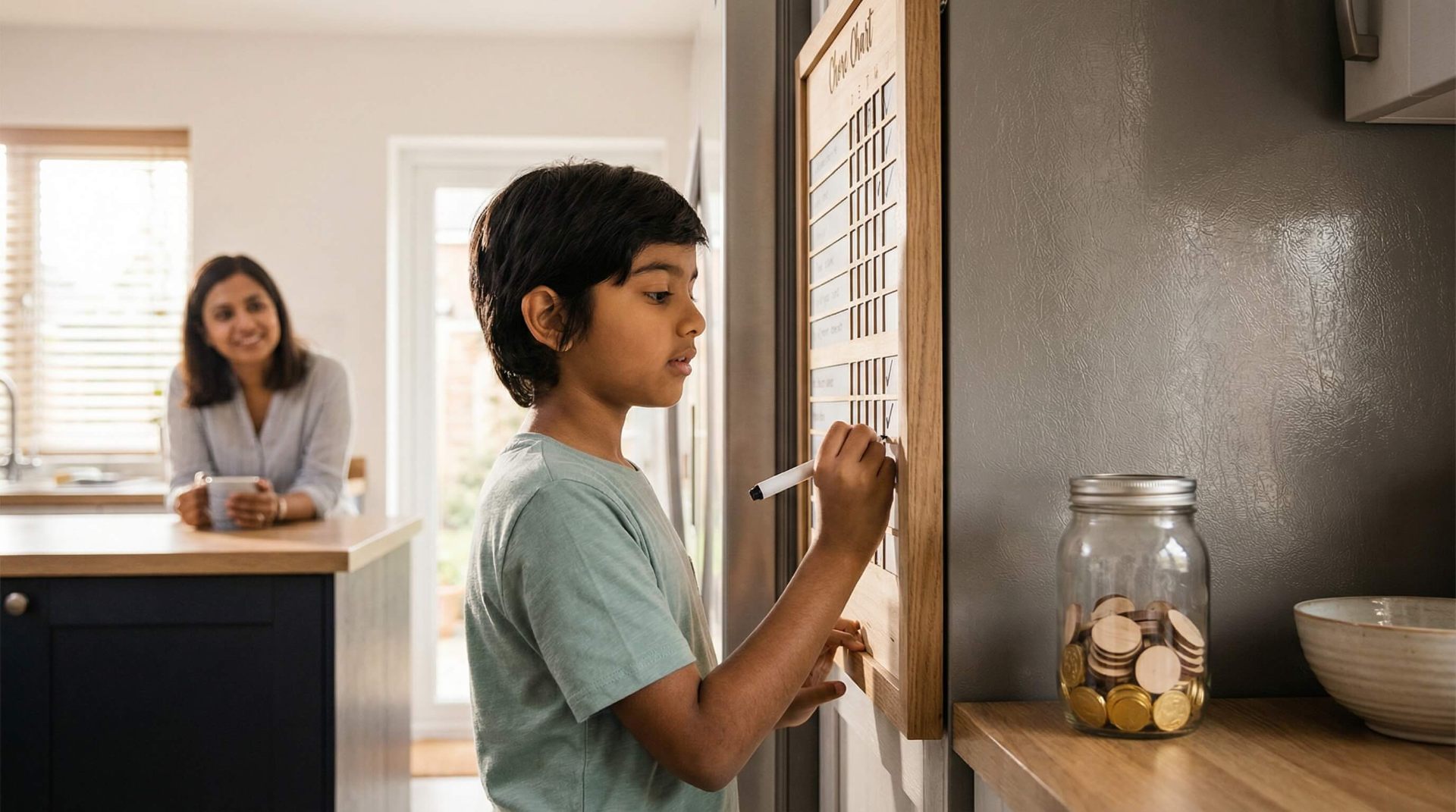

Before: Chores get done when a parent reminds, watches, and follows up. Nobody tracks whether they happened. The reward is vague , "you'll get your allowance on Friday", and the connection between the daily work and the eventual reward is too long for a seven-year-old to hold.
After: The chart is on the fridge. Each task has a row. Each day has a column. When a task is done, it gets marked. The child can see their progress at a glance. The reward is specific and visible. The connection between daily effort and goal is short enough to sustain.
A printable reward chart for kids gives structure to household responsibilities through visibility and a concrete tracking mechanism. This guide includes a free chart you can print today, a short how-to on using it effectively, and an honest explanation of what happens when the novelty fades.
The reward chart
Print the chart below, write in your child's name, fill in 3–5 responsibilities in the task rows, and mark a star or token in the cell each day a task is completed.
|
Task |
Mon |
Tue |
Wed |
Thu |
Fri |
Sat |
Sun |
Week total |
|---|---|---|---|---|---|---|---|---|
|
Daily total |
Tips for filling it in:
- Use 3–5 specific, observable tasks the child can complete independently
- Each task should be achievable on any given day (not "clean bedroom", use "put clothes in hamper")
- Decide in advance what a full week earns, write it at the top of the chart before starting
For a ready-to-print PDF version, download famio, and access it for free inside the app.
How do you use a reward chart effectively?
-
Fill it in with your child, not for them. Sit together. Let the child write (or dictate) the task names. Ownership of the chart increases follow-through.
-
Define what earns a mark before the week starts. The task is either done or not, no partial credit. Decide this together in advance so there is no negotiation at the moment of marking.
-
Mark it the same day. Delayed marking breaks the connection between the action and the record. Mark at the end of each day or immediately after completion.
-
Connect marks to a reward the child chose. A reward chart without a specific, child-chosen goal is a tracking tool. A reward chart connected to something the child genuinely wants is a motivation system.
-
Review it together at the end of the week. Count the marks. Pay out the reward if earned. Name what worked and what to keep doing.
Why do reward charts work in the short term?
A kids behavior reward chart works in the short term for a straightforward reason: children can see their progress. Completed tasks produce a visible mark. Marks accumulate toward a visible goal. The gap between effort and reward is short enough to stay motivating.
The visibility is the active mechanism. Research on token systems in home and school environments consistently shows that visual feedback on progress, marks the child can see and count, is a more reliable motivator than verbal acknowledgment alone. The chart makes the abstract concrete.
Why do they stop working, and what then?
Most reward charts fade between week three and week six. The novelty effect wears off. The tasks become routine. The chart stops getting filled in on busy evenings. Then it stops getting filled in at all.
Three specific limitations of paper charts cause this:
Limitation 1: No automatic reminder. The chart exists only when someone actively manages it. On a day when a parent is tired, ill, or distracted, the chart gets skipped. One skip becomes two. The system loses momentum.
Limitation 2: No running balance. A paper chart cannot tell a child how many tokens they have accumulated across multiple weeks. Parents track it separately, estimates differ, the balance gets disputed, and the child loses confidence in the system.
Limitation 3: One parent at a time. The chart on the fridge is visible to whoever is in the kitchen. The parent who works late cannot see what was completed before dinner. Two parents cannot log completions from the same live record. This is the most common cause of inconsistency in paper-based systems.