
Organizing your family is not the same as structuring it. Most families do one and mistake it for the other, which is why the Cozi subscription and the shared Google Calendar did not stop the morning arguments.
Family organization solves a logistics problem: who is picking up which child, what is for dinner, when is the dentist appointment, which parent has the car on Tuesday. These are coordination problems. They are real and worth solving. A shared calendar, a grocery list app, a meal planner, these are the tools for the job, and they do it well.
Family structure solves a behavioral problem: why do the rules change depending on which parent is home, why does the screen time negotiation happen every single day, why does a child who knows the expectations still consistently not follow them. These are not coordination problems. A shared calendar cannot solve them because they are not coordination problems.
The distinction matters because the two problems feel similar from the inside. Both produce friction. Both drain parental energy. Both involve the same children, the same household, the same adults. But they are different problems that require different tools, and solving the first does not touch the second.
What does family organization actually solve?
Family organization solves the question of what is happening and when. It is the logistical layer of household management.
|
Family organization |
Family structure |
|
|---|---|---|
|
Solves |
Scheduling and coordination |
Behavioral expectations and consequences |
|
Tools |
Cozi, Google Calendar, shared task lists |
Rules module, token economy, family operating system |
|
Problem it addresses |
"Who is doing what and when?" |
"Why won't the kids follow the rules?" |
|
What it cannot do |
Change behavior or enforce expectations |
Coordinate logistics or share schedules |
|
Bottom line |
Makes the calendar run |
Makes the household run |
Apps like Cozi exist directly for the organizational layer. They are well-designed for their purpose. They give both parents visibility into the family's schedule, reduce the "I didn't know about that" conflicts, and make the logistics of a busy household manageable. These are genuine problems, and solving them genuinely helps. A household that runs a shared calendar for the first time reports immediate relief from the scheduling collisions that had been producing daily friction between parents.
What they cannot do is address the rule that one parent enforces and the other doesn't, or the child who tests the same expectation daily because they have learned it does not consistently hold. The screen time limit that holds on weekdays and dissolves on weekends. The child who does homework at the desk with one parent and on the couch in front of the TV with the other. These are not scheduling failures. They are structural ones.
What does family structure actually solve?
Family structure solves the question of how the household behaves, the behavioral and relational layer beneath the logistics.
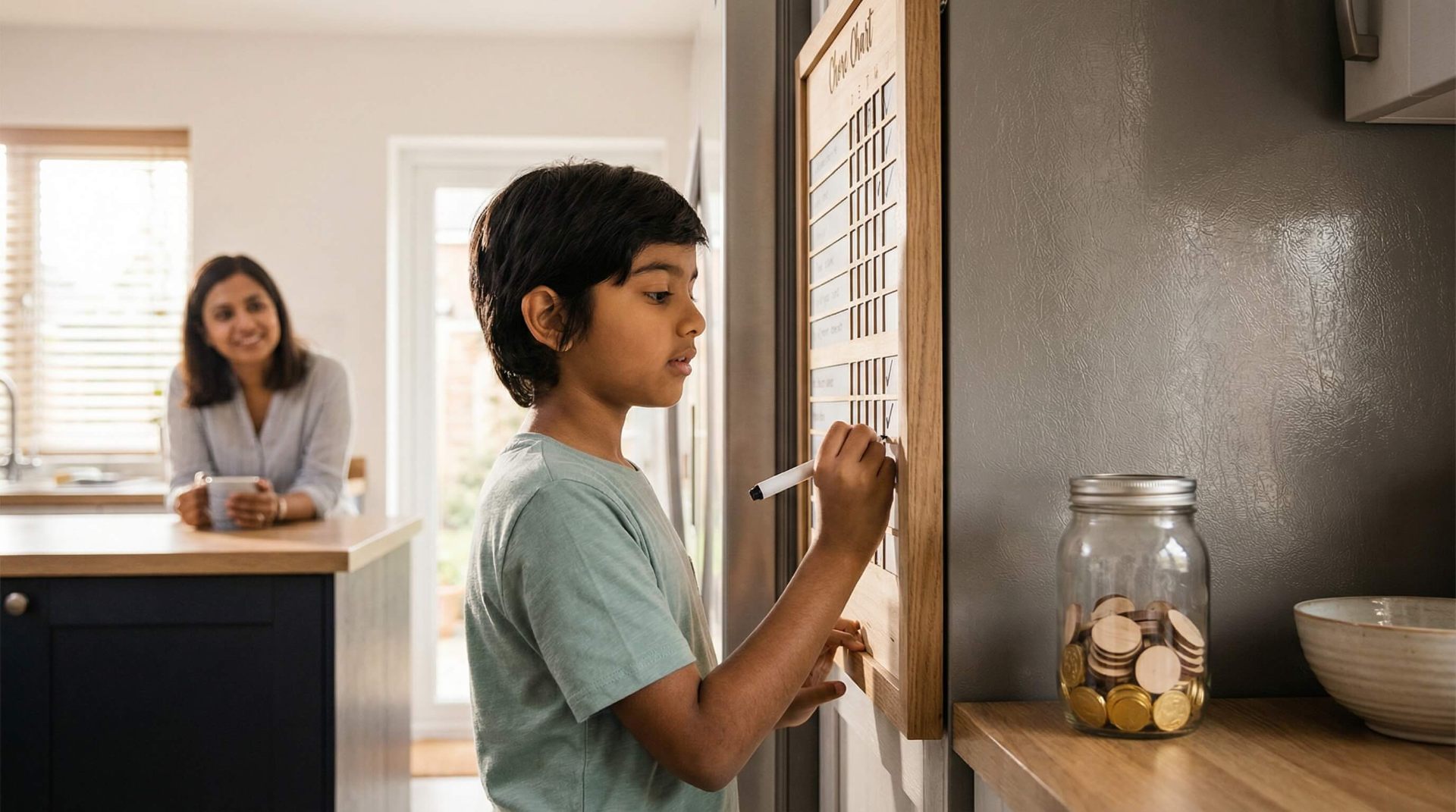
A structured household has written rules both parents enforce identically. It has responsibilities assigned to each child with a known consequence when they're missed. It has a motivation system that connects daily effort to genuine reward. It has agreements about recurring decisions, screen time, allowance, homework expectations, that are made once and referenced rather than re-argued weekly. It runs the same way whether one parent is home or both, whether it's Monday or Saturday.
The family operating system guide defines this in full. The short version: a family operating system app manages the behavioral layer, rules, token economy, chores with consequences, habit cards, and parental alignment, not the logistical layer of calendars and task lists.
Organizing your family tells everyone where to be. Structuring it tells everyone how to behave when they get there.
Which problem does your family actually have?
Most families have both. The diagnostic question is: which one is causing the most friction?
Two tests:
Test 1: "Do we know what's happening this week?" If the answer is often no, missed appointments, scheduling conflicts, nobody knowing which parent is picking up the kids, the primary problem is organizational. A shared calendar solves this.
Test 2: "Do we know what the rules are, and do we consistently follow them?" If the answer is often no, rules that change depending on who's home, children who test the same rule daily, parents who apply the same violation differently, the primary problem is structural. A family operating system solves this.
Many families have already solved Test 1. They have the shared calendar. They know what's happening this week. The logistics run reasonably well. But Test 2 remains unsolved, because nobody built the behavioral layer. The morning is still chaotic not because the schedule is unclear but because the expectations are.
What about families who need both?
Most do. This is not a competition between tools.
Cozi and famio solve different problems for the same household. A family that uses a shared calendar for logistics and a family operating system app for behavioral structure is not using redundant tools. They are managing two genuinely different dimensions of household life.
The mistake is assuming that solving the logistical problem will eventually address the behavioral one, or that adding more organizational sophistication, a better app, more detailed shared lists, more thorough scheduling, will produce behavioral change. It won't. Behavioral structure requires behavioral tools.
The family rules and consequences guide covers how the behavioral layer is built. The token economy for kids guide covers how the motivation system sustains itself over months. Together with the written rules, the family playbook, and the shared parental dashboard, they form a structure that a calendar cannot provide and was never designed to.