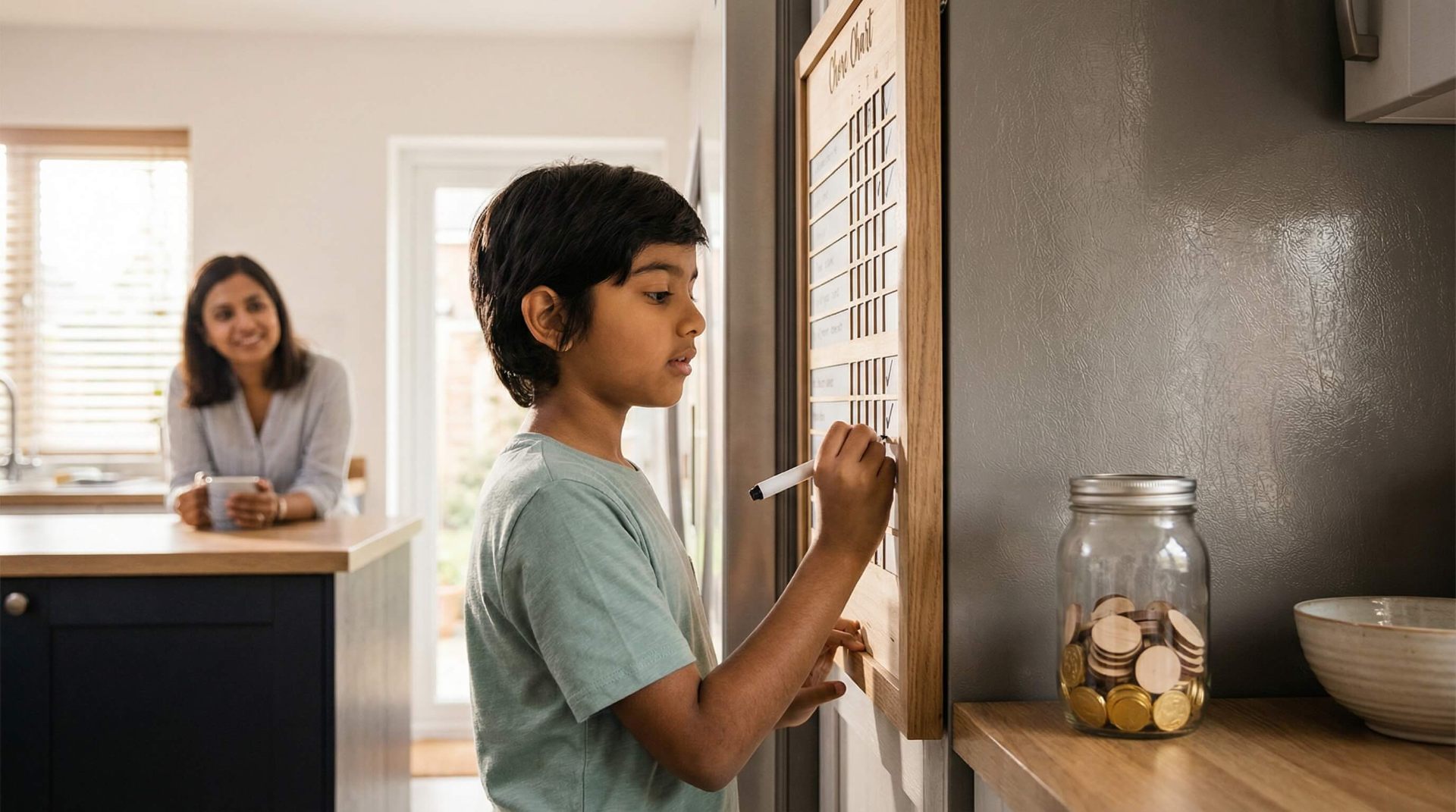

Ask most parents how their family currently makes decisions about rules, chores, screen time, consequences, and expectations, and the honest answer is: in the moment, by whoever is there, based on how much energy is left in the day. There is no written system. There is no shared standard both adults apply the same way. There is a general sense of how things should go, interpreted differently by two people and renegotiated daily by children who have learned exactly where the gaps are. The family runs reactively. It manages crises rather than preventing them.
A family operating system is the alternative to that. It is a parenting system for intact families: a shared, structured set of rules, responsibilities, rewards, habits, schedules, and policies that all family members follow consistently. Not a rigid rulebook. Not a chore list taped to the fridge. A complete, running system that both adults operate the same way, that children understand and can predict, and that covers behavioral expectations, household responsibilities, and the consequences that follow when either is not met.
This guide explains what a family operating system is, why most families run without one, what the six components are, and what a household actually looks like once one is in place.
What is a family operating system?
A family operating system is a shared, structured set of rules, responsibilities, rewards, habits, schedules, and policies that a family agrees to follow together. It covers both behavioral expectations and household logistics. It assigns roles to every family member, including parents. It is built by both adults together, run identically by both adults, and visible to every member of the household.
The operating system metaphor is useful but limited. The point is not the technology analogy. The point is what the term describes: a complete, running set of standards that a family has agreed to, written down, and committed to applying consistently. Not a vague sense of how things should go. Not one parent's interpretation of the rules and another parent's different interpretation. One system, shared by everyone, running the same way every day.
What a family operating system is not: a list of house rules, a chore chart, a parenting philosophy, or a family mission statement. Those are components of a system or inputs to building one. A family operating system is the complete structure that holds all of them together and makes them function as a unit rather than as separate pieces that each family member treats differently.
What makes this framing useful is that it shifts the question from "how do we parent better?" to "how do we run a better system?" The first question implies individual improvement. The second implies structural design. Most family conflict is a structural problem, not a character problem.
Why most families run without a system, and what it costs them
Most families do not consciously choose to run without a system. They arrive at it gradually. The rules accumulate informally over years, never written down, and exist only in each parent's memory where they are stored and recalled differently. The consequences were improvised when situations arose and are now applied inconsistently depending on who is home and how the day has gone. The chore assignments are understood rather than formal, and renegotiated every time a child decides not to remember them.
Three failure modes show up consistently in households without a system.
Inconsistent rules. When rules are not written, they are interpreted. Two adults who agree in general on how the household should run will apply their individual interpretations on a given Tuesday morning, and the child will experience two different households. The child is not confused about which parent loves them. They are confused about which parent's rules are real. That confusion produces testing behavior, which both parents then attribute to the child's character rather than to the inconsistency that generated it. Learn how to write rules precisely enough that both adults apply them the same way.
Unaligned adults. Parenting alignment is the degree to which the adults in a household share the same understanding of and commitment to the family's rules, expectations, and consequences. Without a shared written system, alignment is aspirational rather than operational. One parent holds firm on a rule; the other softens it when the child pushes back. The child learns quickly which parent's version of the rules is the one in effect. A system that both adults built and both adults run removes the gap the child is navigating.
Reactive consequences. When consequences are not predetermined, they are decided in the moment. In-the-moment decisions are shaped by the parent's available patience, the child's current emotional state, and how the day has gone up to that point. The same behavior produces different outcomes on different days, which teaches the child that outcomes depend on parent state rather than on the behavior itself. A system with predetermined consequences removes the in-the-moment decision entirely: the behavior produces the agreed response because the system says so, not because the parent is frustrated or the child is particularly persuasive today.
The six components of a family operating system
A family accountability system has six components. Each addresses a layer of household functioning that, without structure, defaults to improvisation and inconsistency.
Rules
Rules define the behavioral standards the household holds everyone to. They are specific, observable, and written: not "be respectful" but "speak to family members with a normal voice and without name-calling." Not "do your chores" but "complete your assigned responsibilities before 7pm on school nights."
Written rules serve two functions. They remove ambiguity about what counts as a violation, which means both adults can apply the same standard without interpretation. And they make the household's expectations transparent to children, which removes the guesswork about what the actual rules are.
Rules apply to everyone in the household, including parents. A family operating system is not a set of rules for children enforced by adults. It is a shared standard that every family member agrees to hold themselves and each other to.
The number of rules matters. A household with twenty rules has no rules, because no one can track them consistently. Five to eight rules, each written precisely, is enough to cover the behavioral standards that matter most and few enough that both adults remember and apply them without needing to consult a document every time.
Responsibilities
Responsibilities are the assigned household tasks each family member owns on a regular basis. They are specific, assigned to specific people, and scheduled: not "help around the house" but "take out the recycling every Tuesday morning before school."
The key design principle is that responsibilities are not optional and are not subject to daily negotiation. They were agreed to in advance. When a responsibility is not completed, the system responds: the daily token is not earned, and a habit card is assigned for that specific task. The parent does not need to argue about why the responsibility matters. The system already answered that.
The guide to age-appropriate chores covers what children at different developmental stages can realistically own.
Rewards
A reward system serves two functions in a family operating system. It provides the motivational structure that makes consistent effort sustainable, and it gives children genuine agency over their own experience: what they are working toward, what it costs, when they redeem it.
Rewards in a well-designed system are child-chosen and written down. Children propose what they want to work toward. Parents approve the menu and set token costs. The costs do not change once set. The child earns on their own timeline and spends when they have enough. There is no adult gatekeeping at the point of redemption.
Habit Cards
Habit cards are positive discipline practice cards assigned after a rule violation or a missed responsibility. Positive discipline is the approach of building the skill the child is missing rather than penalizing the absence of it. Each habit card specifies a positive behavior to practice daily for a set period: the skill the violation revealed was missing, addressed through daily practice.
A child who spoke unkindly to a sibling is assigned a card requiring one intentional act of kindness to that sibling each day for a week. The violation is acknowledged. The response is constructive. The tokens the child has already earned are never taken away. Tokens are earned property. The consequence for a rule violation is a practice requirement, not a deduction.
Schedules
Schedules bring time structure to the family operating system. Morning routines, after-school routines, bedtime sequences, weekend rhythms. When these are written and shared, they stop being daily negotiations and become predictable sequences both children and adults can rely on.
A structured schedule reduces the number of decisions that have to be made each morning, which reduces friction at the exact moments when both adults and children have the least available patience. The answer to "can I watch TV before school?" is not a daily parental judgment call. It is in the schedule.
Policies (Family Playbook)
Policies, also called the Family Playbook, are the family's written positions on recurring situations that sit above daily rules but still need a standing answer. Screen time limits. Homework expectations. What happens on school nights versus weekends. Sleepovers, devices in bedrooms, what counts as a situation that warrants interrupting a parent.
The Family Playbook is decided once. Both adults agree, write it down, and refer to it when the situation arises. The question does not need to be renegotiated every time because the answer already exists. This is the layer that removes the most low-grade, repetitive decision friction from a household's daily operation.
What changes when a family runs on a system
The first two to four weeks after installing a family operating system are an adjustment period. Children test the new structure. Parents find their own consistency gaps. Some rules need adjusting. Some reward costs need recalibrating. This is expected and is not a sign the system is not working. Testing is the child confirming whether the new structure is real.
What shifts after the adjustment period is the household's operational baseline.
Conflict that was daily becomes infrequent. The rules are written. The consequences are predetermined. When a boundary is tested, the system responds rather than a parent escalating. The emotional temperature of the household drops because most daily friction was structural rather than relational. Two adults who were frequently at odds over how to respond to the same situation now both reach for the same answer, because the answer is written down.
Children become more predictable, not because they have changed but because the environment has. A child who can form an accurate internal model of what the household expects and what follows when those expectations are not met does not need to test repeatedly to map the limits. The limits are already known. The energy that was going into mapping and testing the system redirects into other things.
Both adults operate from the same playbook. One parent is not stricter and the other softer, because the rules are written and the responses are predetermined. The child experiences consistency across both adults, which is the condition that most directly supports the development of self-regulation. Children in consistently structured households show lower rates of behavioral problems and stronger self-regulation capacity than children in households with warm but inconsistent adults.
Parents spend less time managing and more time being present. The system handles the behavioral structure layer. Parents handle the relationship layer. A family operating system is what keeps those two roles from collapsing into each other every evening. The parent who has a system does not have to become the rule every time a rule is broken. The rule is already there.
The engine that makes it run: the token economy
The six components of a family operating system need a connective tissue: a mechanism that links daily behavior to visible, meaningful outcomes for children. The token economy is that mechanism.
A token economy is a system where children earn tokens by completing their daily responsibilities and meeting the household's behavioral standards, then spend accumulated tokens on rewards from a menu they helped build. It is based on operant conditioning, the behavioral principle that behavior followed by a positive consequence tends to repeat.
What the token economy provides inside a family operating system is daily accountability with daily feedback. The child does not wait weeks to see whether their effort is producing anything. They see their balance update. They know exactly what they are earning toward. The outcome of a good day is immediate and visible. For younger children, this immediacy is what makes the system motivating at all. Abstract future rewards do not sustain consistent effort. A visible balance building toward a specific, child-chosen goal does.
The token economy is also what prevents the habit card system from feeling punitive. Tokens are the child's property and are never deducted as punishment. Violations produce habit cards. Missed responsibilities produce habit cards. The reward balance is untouched by behavioral consequences. The system is designed around building behavior, not penalizing its absence.
Without the token economy, the six components of a family operating system are behavioral structure with no motivational engine. The rules tell children what is expected. The token economy gives children a daily reason to meet those expectations, a visible record that they are doing so, and a direct line from their effort to something they actually want. That connection is what makes the system self-sustaining past the first month.
View the complete research basis, design principles, and implementation guide for the token economy.
How to install a family operating system
The installation sequence matters. A family that tries to build all six components simultaneously usually builds none of them well. The sequence below produces a stable system within four to six weeks.
Step one: Rules. Start here. Both adults sit down and write the five to eight rules that matter most in the household right now. Make each rule specific and observable. Write down what counts as a violation and what the consequence is. Do this before introducing anything to the children. Both adults need to be aligned on the written system before it is presented to anyone else.
Step two: Responsibilities. Once the rules are stable, assign household responsibilities. Each child gets a written list of what they own, on which days, and by what time. Specific and verifiable. A responsibility that cannot be checked cannot be consistently enforced.
Step three: Reward menu. Sit down with each child and build their reward menu together. Let them propose what they want to work toward without filtering first. Review the list together, assign token costs, and begin earning immediately. Starting the token economy before the rules and responsibilities are stable is one of the most common installation errors.
Step four: Token economy. With rules, responsibilities, and a reward menu in place, the token economy has what it needs to run. Establish the daily earn mechanics, add the streak bonuses, and configure the manual bonus categories. The system is now operational.
Step five: Schedules. Once the behavioral structure is running, add time structure. Write the morning routine, after-school routine, and bedtime sequence for each child. Post them where the child can see them. The schedule supports the responsibility layer by making when the responsibility happens predictable rather than negotiated.
Step six: Family Playbook. In the weeks after the system is running, identify the recurring questions still generating friction and write standing policies for them. Screen time, homework location and timing, weekend rules. Each policy decided once removes one more source of daily negotiation.
The family constitution template provides a complete starting framework for the rules and policies layers, with example language for the most common household rules.
How famio implements this as a digital platform
famio is a family operating system app that maps each of the six components above to a dedicated module. Both parents access the same dashboard. Both see the same rule list, the same responsibility assignments, the same token balances, and the same violation and habit card history. There is no version of the system that exists only in one parent's understanding of it.
Rules module. Written rules with violation logging and habit card assignment. Cards are drawn randomly from the child's per-child deck without repeats. The Strike rule assigns all available cards for serious defiance. Cards double in count if not accepted politely within the ten-minute cooling period.
Responsibilities module. Assigned tasks with daily check-off, tied directly to the token economy. At midnight, the platform checks two conditions: all responsibilities completed and no violations logged. If both pass, the daily token is awarded. If either fails, no token is awarded that day. Missed responsibilities each assign one habit card, separate from the daily token outcome.
Rewards module. Child-configured menus across Experiences, Privileges, and Treats and Gifts. Token costs set in advance. Children redeem when they reach the cost. Parents approve the menu once and do not gatekeep individual redemptions.
Habit Cards module. Cards assigned after violations or missed responsibilities. Wild Cards let the parent choose the practice activity. Grace Cards release the child from one specific card. Progress is visible to both parents and, for families connected to a practitioner, to the therapist or coach between sessions.
Schedules module. Shared family schedule visible to all household members. Supports the responsibility layer by making timing predictable.
Policies module (Family Playbook). Standing written policies on recurring household situations, accessible and editable by both adults.
For families working with a therapist, parenting coach, or counselor: famio's practitioner dashboard gives the professional visibility into the family's rules, consistency patterns, and progress between sessions. Our parenting app for therapists and coaches is built for practitioners who use home-based structure systems with their client families.
The research basis for why consistent structure combined with warmth produces the strongest child outcomes.