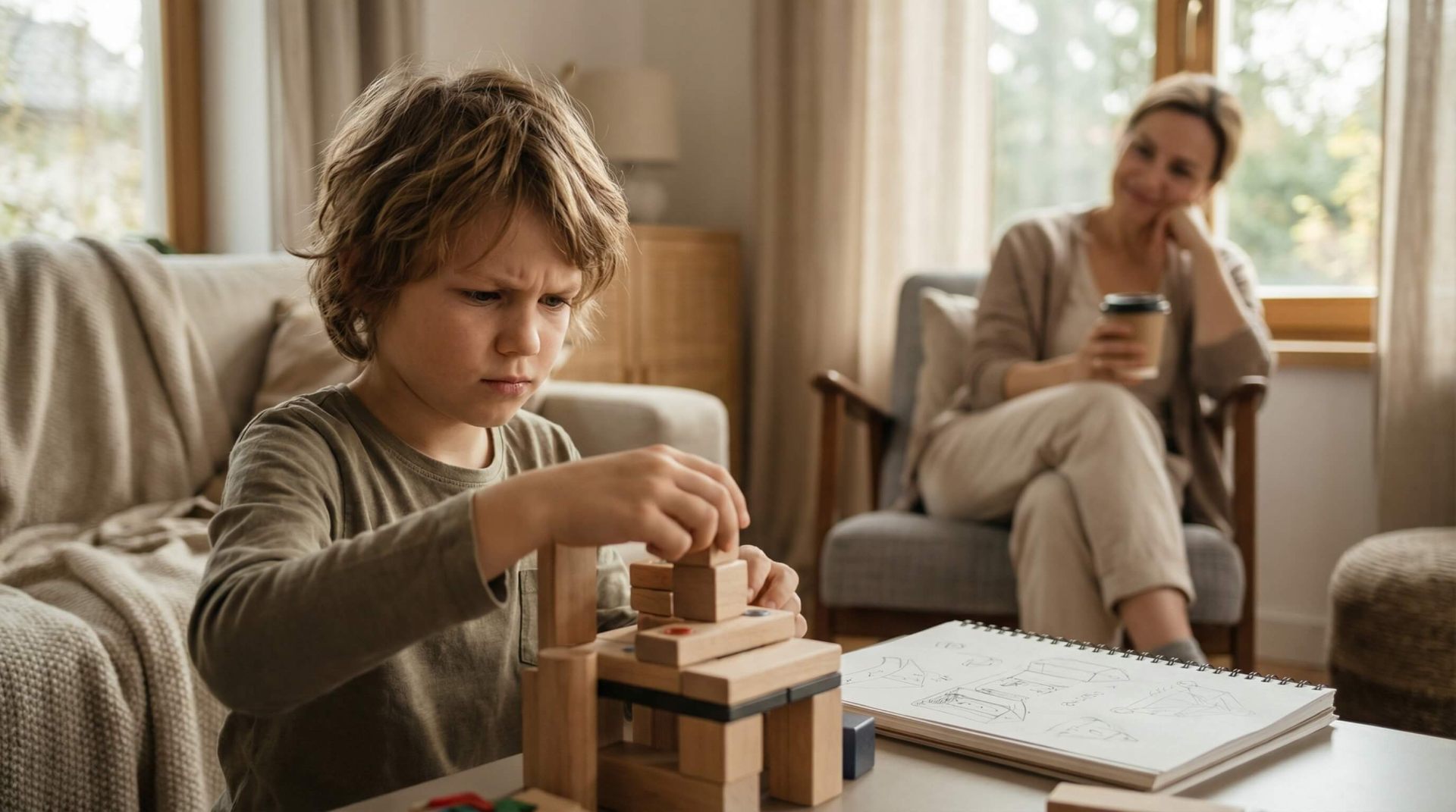

It's 6:47pm on a Tuesday. Dinner is in the oven. The eight-year-old has been told three times to start homework. The five-year-old is crying about something involving socks. A work message arrives that needs a response tonight. The eight-year-old, who has not started homework, is now arguing about why the rule about homework before screens is unfair.
The parent responds in a way they will feel bad about later.
Not because they are a bad parent. Not because they lack patience by nature. Because they have been holding the line on the same requests for forty minutes with no response, and the only thing left that generates any response at all is volume and visible frustration.
This is not a patience problem. It is a structural options problem, and it has a structural solution. When every response below escalation has stopped working, escalation becomes the only available lever. The fix is not more patience. It is more options between the first request and the point of no return. When every response below escalation has stopped working, escalation becomes the only available lever. Learning to be a more patient parent starts by understanding that.
Why do parents lose their temper?
Parental self-regulation, the capacity to manage one's emotional response under stress, is not a fixed trait. It depletes under sustained frustration, particularly when that frustration is producing no effective result.
Losing your temper with your child is almost never the result of insufficient love or insufficient commitment. It is the result of running out of responses that work before reaching that point. The parent who asks once, twice, three times, who reminds, repeats, raises their voice, threatens a consequence that never fires, is not failing to stay calm. They are being rational. If the only thing that produces a response is visible distress, visible distress is what the moment will produce.
Bridgett, Burt, Edwards, and Deater-Deckard's 2015 meta-analysis in Psychological Bulletin synthesized research on parental self-regulation across 50 years of developmental psychology. Their finding: parental self-regulation and child self-regulation are interdependent. Parents who manage their emotional responses more effectively raise children who develop stronger self-regulation. The mechanism runs both ways, a parent's capacity to stay regulated in difficult moments provides a co-regulatory anchor for the child's own nervous system. This is the co-regulation research: a calm parent does not just model calmness. Their regulated state actively helps the child's nervous system regulate.
Yelling is not a failure of willpower. It is what happens when every option below the threshold has already been exhausted.
What makes it harder to stay calm than it should be?
Three structural conditions make parental self-regulation harder regardless of temperament or intention.
The absence of automatic responses. When a child refuses homework, the parent has to decide what to do, in the moment, under frustration, while also managing dinner and the five-year-old and the work message. That real-time decision load is where patience goes. A predetermined consequence that fires automatically removes the decision. The parent does not have to figure out what the response should be while they are already frustrated. The system has already decided.
Carrying the enforcement alone. A parent who is the household's primary rule enforcer, because the other adult rarely enforces, or because there is only one adult, carries a load that is not designed to be carried by one person. Repeated enforcement requests that produce no response, over months and years, deplete regulation capacity in ways that individual mindfulness techniques cannot fully address. The structural fix is alignment, both adults enforcing identically, not just better breathing exercises.
The third ask. Most households have an informal threshold: the first request is not serious, the second request is slightly more serious, the third request is when something actually happens. Children learn this calibration precisely. They wait for the third ask. The parent who knows this calibration is in place has already set up the Tuesday evening scenario before it begins. When the first clear request carries a known automatic consequence, the third-ask dynamic dissolves.
What does the research show about parental self-regulation?
Bridgett et al.'s (2015) meta-analysis is worth understanding in practical terms because it reframes the stay-calm challenge usefully. Their finding is not that some parents are simply more regulated than others by nature. It is that self-regulatory resources are dynamic, they fluctuate with sleep, stress, sustained frustration, and the quality of the parenting environment itself.
A parent who is operating inside a structured household system, where rules are written, consequences are automatic, and both adults are running the same standards, is a parent whose daily self-regulatory load is reduced. Fewer real-time decisions. Fewer enforcement negotiations. Fewer moments where the only available response is escalation. The same parent in the same evening scenario, but with a system that responds before they have to, is a meaningfully different version of that scenario.
This is the structural argument for why systems help parents stay calm: not because knowing the theory makes you calmer, but because the system reduces the frequency of the moments where the theory gets tested.
What actually helps in the moment?
In-the-moment regulation techniques are real and useful. The research on them is genuine. The issue is that they are often presented as the primary solution when they are better understood as supplementary to a functional household system.
Pause before responding. A two-second pause between the child's behavior and the parent's response is enough time for the prefrontal cortex to engage rather than the amygdala. This is not mystical, it is the neurological window between stimulus and choice. The pause does not have to be long. It has to exist.
Name what you are seeing, not what you are feeling. "I can see you're frustrated about the homework rule" lands very differently than "I'm furious that you still haven't started." The first acknowledges the child's state. The second adds emotional load to an already loaded moment. Acknowledging the child's experience is not agreeing with them, it is providing the co-regulatory anchor that Bridgett et al.'s research identifies as the active mechanism.
Apply the consequence, then exit the interaction. The predetermined consequence exists precisely so the parent does not have to stay in the moment escalating. Log the violation. Assign the Habit Card. Tell the child what has happened in one sentence. Leave the room. The system has responded. The parent does not also need to.
Return to connection after the moment has passed. Staying calm in the hard moment is easier when the relationship has enough warmth in it that the correction does not feel like the whole texture of the relationship. This is the warmth side of the warmth-and-structure equation, not as a reward for the child's behavior, but as what makes the structure feel like care rather than control.